“What Are We Waiting For?”: Aggressors for Peace and the 1950 Preventive War Controversy
Type: Article
Status: In-Progress
Presented at the 2025 Society for Military History (SMH) Conference.
As U.S. forces in South Korea scrambled to maintain the Pusan Perimeter in August 1950, Secretary of the Navy Francis P. Matthews called on Americans to become “aggressors for peace” by launching a preventive war against the Soviet Union. Instead of merely containing communism, Matthews and other civilian and military officials wanted to wage an unlimited war to defeat and destroy communism once and for all. The calls for preventive war divided Americans into hawks and doves. Driven by their experiences and memories of World War II, and fervent anti-communism, Korean hawks still believed that victory was worth any cost. Veterans, conservatives, and anti-communists supported aggression, roll-back, nuclear attacks, and all-out war to achieve total victory over the USSR and communism. Korean doves, on the other hand, did not believe that victory was worth any price, and they denounced preventive war as impractical, un-American, and immoral. Intellectuals, the clergy, and most of the nation’s leading journalists doubted whether the United States could accomplish much good by doing evil and favored limited war to avoid the agonies of World War III and nuclear conflict. The controversy crystallized the White House’s values, attitudes, and ethics about the Korean War, and the Truman administration came to believe that total victory and unconditional surrender had become impossible and immoral. The administration subsequently substituted the status quo for victory, containment in place of roll-back, and limited war instead of unlimited war – and after renouncing unlimited war, the United States has never looked back.
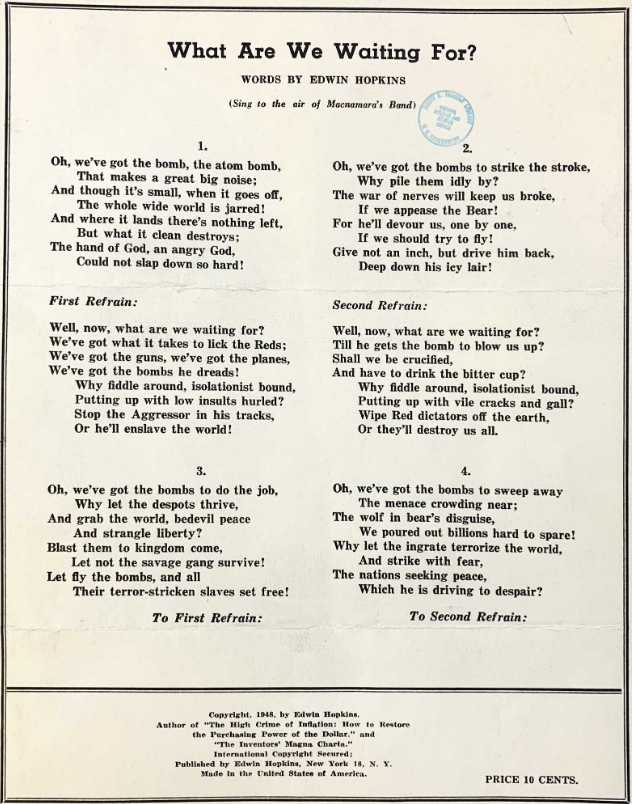
Edwin Hopkins to Francis P. Matthews, August 29, 1950; Boston Speech, Public Opinion Mail - Pro, Box 40, Francis P. Matthews Papers, Truman Library.