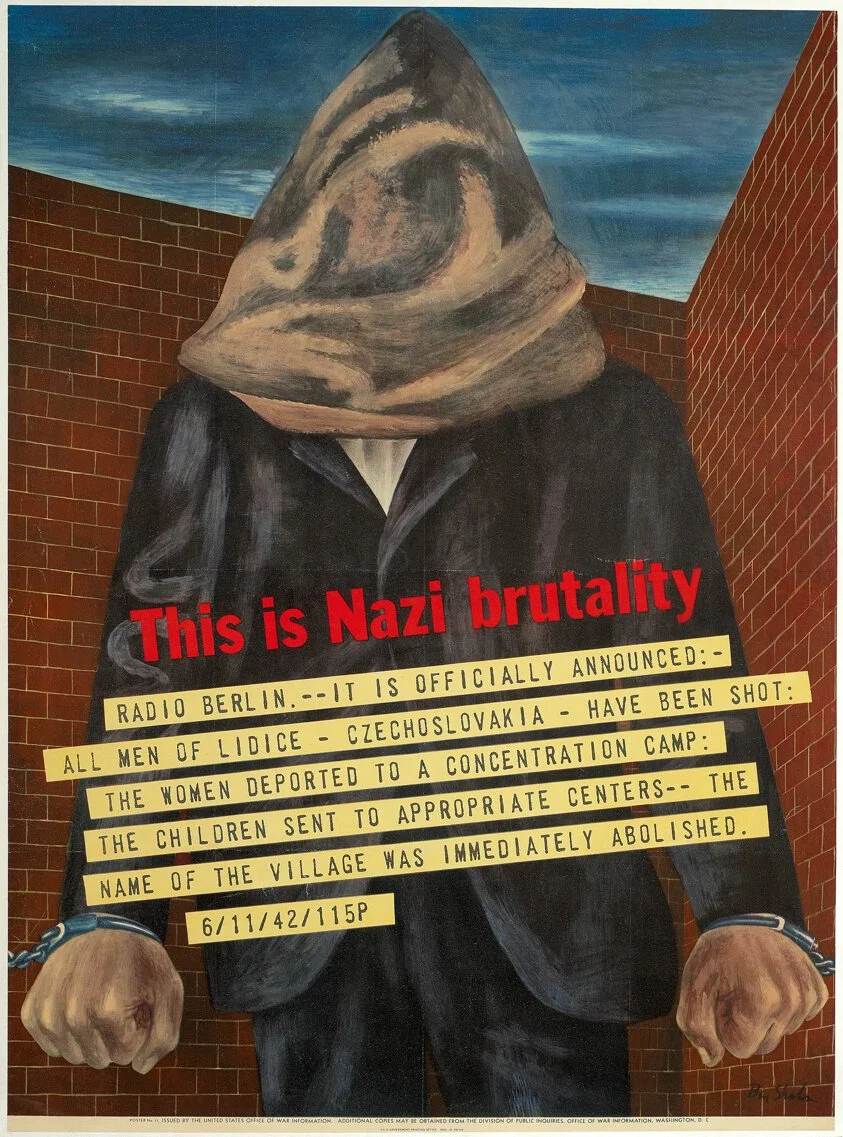
“This is Nazi Brutality:” The Transnational Movement to Remember the Unparalleled War Crime of Lidice
Type: Article
Status: Under Revision
This project considers the uniqueness of the Lidice war crime and argues that the unparalleled destruction provoked a transnational movement dedicated to resisting the Nazi atrocity by allowing the name of Lidice to live on. The Nazis destroyed thousands of villages during World War II, but the annihilation of Lidice was distinctive because it was ordered directly by Adolf Hitler within the Third Reich, because the village was not only razed but erased, and because the Nazis publicized its destruction, rather than concealing it. The unparalleled annihilation made Lidice the most infamous symbol of Nazi barbarism before the scale and monstrosity of Auschwitz became more widely known.
Outraged by the Nazis’ singular atrocity, the international community called for exceptional retribution, reconstruction, and remembrance. The Czechs and Allies vowed vengeance against German cities, British coal miners organized a fundraising campaign called “Lidice Shall Live” to rebuild the village, and Americans formed their own “Lidice Lives” movement which paid tribute to Lidice through artistic compositions. Most importantly and distinctively, the movement resisted the annihilation of Lidice by renaming an Illinois town “Lidice” so that the Czech village would symbolically live on. The committee encouraged every other member of the United Nations to do the same and designated 25 October 1942 as Lidice Memorial Day. Lidice thus became a transnational movement as local activists and Czech emigres erected monuments and memorials throughout the Western Hemisphere and renamed towns in Mexico, Brazil, and Panama. Lidice even became a familiar name for Czech children and baby girls in Latin America. Today, commemorations and memorials persist due to the influence of Czech culture and Lidice remains a singularly potent anti-Nazi symbol.
Ben Shahn, This is Nazi Brutality (1942)