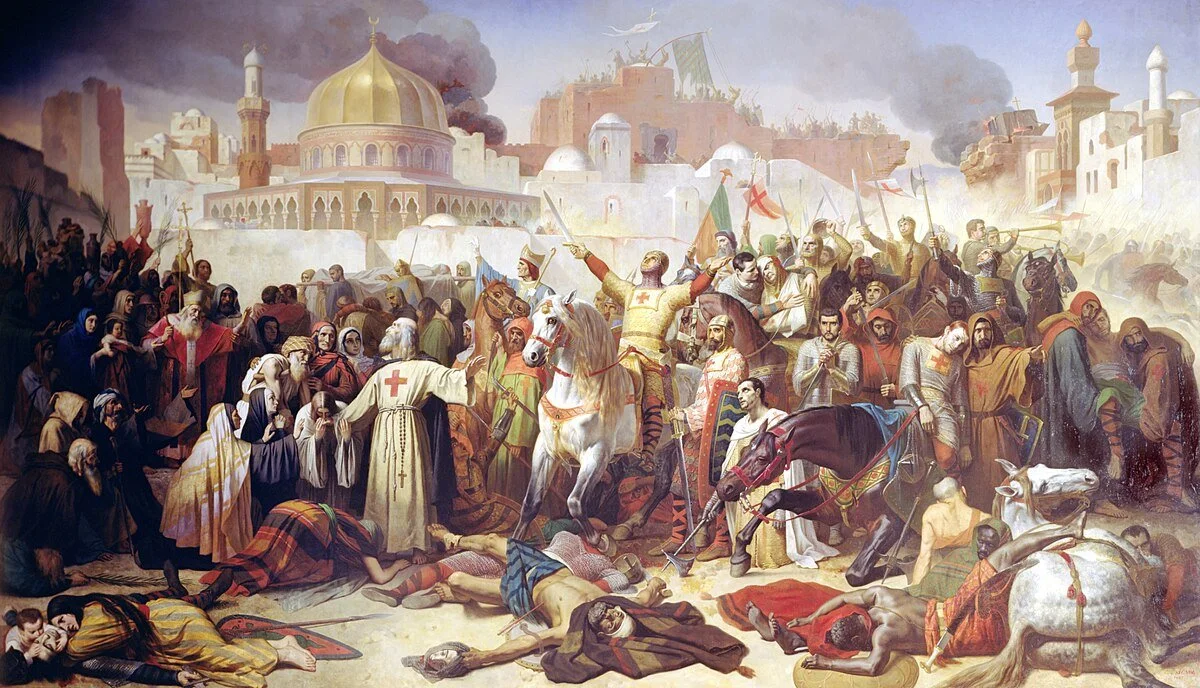
Émile Signol, Taking of Jerusalem by the Crusaders, 15th July 1099 (1847)
Honors Intellectual Traditions: Might & Right
Level
Undergraduate
Type
Seminar
“Right, as the world goes, is only in question between equals in power, while the strong do what they can and the weak suffer what they must.”
Does “might” make “right” or does “right” make “might”? This course explores the relationship between power and morality by considering some of the historical approaches and answers to universal questions such as: What is justice? What makes war just or unjust? Where do morality and ethics come from? Do the ends justify the means? How can human beings live decently in an indecent world? How much evil must we do in order to do good? What powers should states use and what rights should individuals claim to create a more just society?
To investigate these profound and expansive questions, this course will examine seminal ancient, medieval, and modern texts related to the theme of “might and right.” These texts will demonstrate the relevance of the past to students and promote historical literacy – the knowledge, skills, methods, and habits of mind specific to historical thinking – as well as an appreciation of how the present is shaped by the past.
By engaging with these historical texts firsthand, this course enables students to “stand on the shoulders of giants” but, more importantly, this course invites students to experience new ideas for themselves as scholars in their own right. Indeed, this course inspires epiphanies among students by enabling them to converse with their “real” teachers from history like Cicero, Shakespeare, Milton, Hobbes, Locke, Rousseau, Dostoyevsky, and others. Without relying on secondary interpretations or gilded commentaries, students will encounter intellectual challenges directly, respond independently, and think for themselves.
This course will also advance students’ learning through critical speaking and writing exercises in the form of Socratic seminars, formal debates, experiential learning, and online exchanges. Through critical essays, students will analyze Plato’s Republic, compare Augustine and Aquinas, translate Machiavelli into modern speech, and create a final project that synthesizes the writings and perspectives from class – from the Abrahamic Traditions to Rawls’ Theory of Justice. These opportunities to practice their thinking, on paper and in person, will stretch students intellectually and sharpen their reasoning, deliberations, and judgment about issues of power and morality.